Best AI Pet Tools for Cats in 2026: Feeding, Litter, and Behavior
Compare AI pet tools for cats by household problem, from shared feeding and litter tracking to outdoor safety, home cameras, and careful routine observation.
Quick answer
What this guide covers
The best cat technology depends on the record your household is missing. Match feeders, litter systems, cameras, trackers, and sound tools to a specific task.
Key takeaways
- Date and time.
- What the device recorded.
- What a person saw.
Article content
Cat technology is most useful when it clarifies one quiet part of a cat’s routine. A connected feeder can separate food access, a litter system can add visit and weight history, a camera can show what happens in one room, and a GPS device can support outdoor recovery planning. None of these outputs explains the whole cat or diagnoses a health problem.
Choose the tool by the missing record. The right choice for a single indoor cat may be a simple log. The right choice for a multi-cat home may be individual access control. A senior cat with an established veterinary plan may need a shareable timeline rather than a new score.
Choose the record before the product
Write the household problem in one sentence. “I do not know which cat ate” is a feeding-access problem. “I cannot tell which cat used the litter box” is an identification and setup problem. “I do not know what happens when the cat is alone” is a camera-placement problem. “I need a recovery plan for an outdoor cat” is a location and contact problem.
Then decide what a good record would contain: time, event, individual cat, surrounding context, and any action taken. This prevents a broad app dashboard from becoming the goal.
Best fit for a multi-cat feeding problem
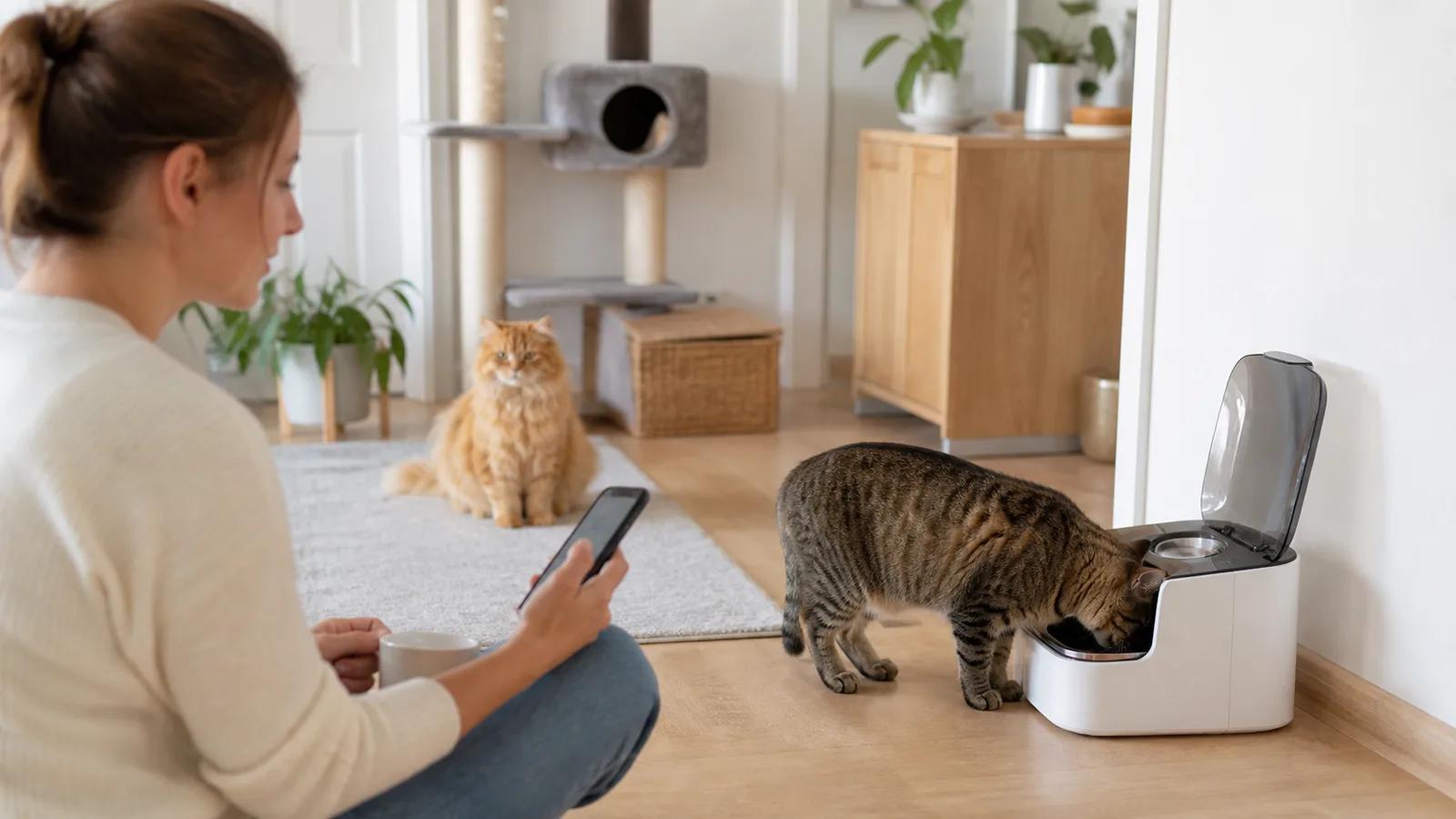
Sure Petcare describes a Microchip Pet Feeder Connect that recognises a pet’s microchip or RFID tag and records feeding information. Individual access can be useful when cats share a room but should not share the same food record.
Test the feeder with every cat. Check that the opening is comfortable, the correct cat is recognised, and another cat cannot easily push in. Keep water and alternative resources accessible. The device records access under its own conditions; it cannot prove that every gram offered was eaten or that food was not obtained elsewhere.
If there is only one cat and one caregiver, a consistent written log may be faster and cheaper. A smart feeder becomes more compelling when several people feed the cats or when bowls are difficult to monitor.
Best fit for litter and weight history
Whisker says Litter-Robot 4 can provide visit and weight insights in the Whisker app. That can help a household organise a history, particularly when a cat uses the system consistently. Product pages also describe differences between the standard app view and additional history or insight features.
Treat the record as an observation aid. Check the surface, calibration, litter setup, and whether one cat enters with another. A visit count cannot explain a change in access, stress, cleaning, or the cat’s wider routine. Keep the date, device event, visible context, and any equipment change together.
Best fit for home cameras
A camera is useful when the question is visible and tied to one place. Point it at the doorway, feeding area, or room transition that matters. Petcube documents alerts for cat and other household events, but lighting, sound, view, network, and multiple pets affect what the camera can detect.
Review the clip instead of relying on its label. Record what happened before and after the event, and mark false alerts. A camera cannot tell you what happened outside its frame, and the absence of an alert is not proof that no event occurred.
Best fit for outdoor cats
A GPS wearable can support location and recovery planning. Tractive describes GPS and activity or sleep features for cats, with compatibility and feature availability depending on the tracker. Check weight, fit, safety design, battery, cellular coverage, and whether the cat accepts the device before making it part of outdoor routine.
Keep the ordinary recovery plan current. A tracker does not replace a microchip, updated contact details, or a realistic way for another person to return the cat. If the device loses power or coverage, the plan still needs to work.
Best fit for vocalisation and enrichment
MeowTalk describes broad AI-supported interpretations of cat vocalisations. FluentPet describes connected buttons that help households build associations between presses and outcomes. These may be interesting enrichment tools, but neither should be treated as literal translation or proof of emotion, pain, or illness.
Record the sound or button press with its time, location, body posture, nearby people or animals, and what happened next. The context is more useful than an isolated label. If the vocal routine changes alongside appetite, movement, litter use, or other concerning signs, discuss the complete observation with a veterinarian.
Match the setup to the household
One indoor cat
Start with a short feeding, litter, and ordinary-observation log. Add one device only when it solves a defined gap. A camera can cover a period when nobody is home; a smart litter system may be unnecessary if one person already checks the box consistently.
Multi-cat home
Prioritise individual identification. Separate feeding stations or a microchip feeder can be more useful than an activity score. If the litter system cannot reliably distinguish cats, keep separate human notes instead of assigning an event to the wrong cat.
Outdoor cat
Prioritise recovery, fit, coverage, and battery. Test the device indoors, update contact information, and keep a second identification route.
Cat with a veterinary monitoring plan
Ask the veterinary team which fields and time period would be useful. Export or write the relevant trend, but keep the original records and note device gaps. Do not use an app alert to change food, medication, or treatment without professional guidance.
Review the record without overreading it
Use four fields for every important event:
- Date and time.
- What the device recorded.
- What a person saw.
- What changed around the event.
Mark travel, visitors, a moved bowl, a litter change, missed sync, and feeding outside the normal area. Review weekly for missing entries and repeated circumstances. A pattern that persists or comes with other signs deserves professional attention; the tool does not need to assign a diagnosis first.
Frequently asked questions
What is the most useful AI tool for a multi-cat home?
The most useful tool is usually the one that identifies individual access. A microchip feeder or clearly separated feeding stations may solve more than a general activity dashboard.
Can a cat translator tell me whether my cat is sick?
No. Sound labels and button associations cannot diagnose illness. Use a changed routine as a reason to observe more carefully and contact a veterinarian when appropriate.
Does a GPS tracker work for every cat?
No. Fit, weight, safety design, battery, network coverage, and tolerance vary. Test the device before relying on it outdoors.
Can smart litter data replace cleaning and observation?
No. The history can add timing and trend information, but it does not replace cleaning, visual checks, or attention to the cat’s overall routine.
Sources
Author information

Written by
Mei Lin
Feline health content author
A fictional editorial profile focused on cat hydration, appetite changes, digestion, and daily care observations.
Areas of focus
- cat hydration
- appetite changes
- digestion
- daily care
Profile note: Fictional profile. No real license, institution, or professional credential is claimed.

Reviewed by
Julian Reed
Pet health fact-checking editor
Areas of focus
- fact checking
- risk language
- health claims
- editorial review